The United Arab Emirates built one of the most ambitious highway networks in the Middle East in a single generation. Understanding how E11, E311, and their tributaries connect the seven emirates is essential for anyone who drives here — resident or visitor alike.
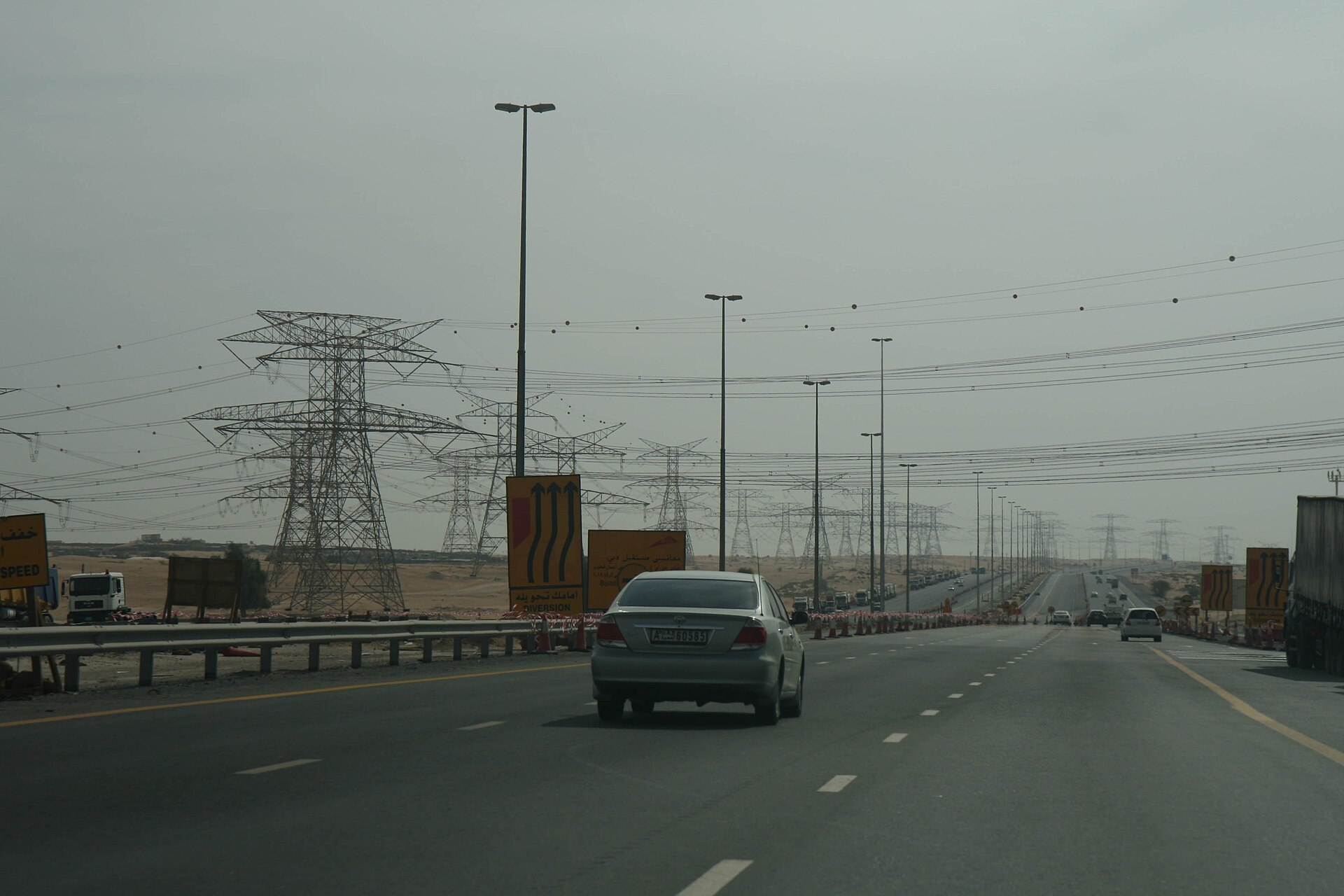
E11: Sheikh Zayed Road and the coastal spine
E11 is the artery most drivers know, even if they never learn its designation. In Dubai it runs as Sheikh Zayed Road — eight lanes of controlled flow past the Marina towers, DIFC, and the Trade Centre before continuing toward Abu Dhabi as the main inter-emirate corridor. North of Dubai, E11 becomes the route through Sharjah, Ajman, Umm Al Quwain, Ras Al Khaimah, and eventually the Omani border at Al Buraimi.
The road's character shifts dramatically along its length. Through central Dubai it is an urban canyon of glass and steel. Past Sharjah's industrial zones it widens and straightens. In Ras Al Khaimah it traces the Gulf coast with views of mangrove flats and fishing harbours. Drivers treating E11 as a single homogeneous road often underestimate how much travel time varies by segment.
Dubai's Salik electronic toll system operates on several E11 segments and connecting roads. Tolls are charged automatically via RFID tags. Rental vehicles typically include a tag; verify with your provider. Unregistered passage incurs administrative fees beyond the standard AED 4 per gate.
E311: Sheikh Mohammed Bin Zayed Road
E311 parallels E11 inland, serving as the primary freight and commuter alternative through Dubai and Sharjah. Sheikh Mohammed Bin Zayed Road (SMBZ) handles enormous commercial traffic — container trucks, buses, and inter-emirate coaches — while offering residential communities in Dubailand, Mirdif, and Sharjah's eastern suburbs direct highway access.
The E311/E611 interchange complex near Dubai Investments Park represents one of the region's largest junction designs. During morning peak, the merge from E611 onto E311 southbound is among the most congested manoeuvres in the country. Drivers unfamiliar with the lane geometry should position early and avoid last-second crossings across three lanes of HGV traffic.
E611 and the outer ring
E611 — Emirates Road in its western sections — functions as an outer orbital route connecting Abu Dhabi approaches with Dubai's southern industrial zones and the E311 corridor. For drivers bypassing central Dubai entirely, E611 to E311 provides a viable alternative that adds distance but often saves time during Sheikh Zayed Road peak congestion.
Fast lane systems and etiquette
Several UAE expressways designate leftmost lanes for overtaking or minimum-speed traffic. On Abu Dhabi highways, the left lane is legally reserved for overtaking — lingering in the fast lane while travelling below the flow of traffic is fineable. Dubai applies similar conventions though enforcement intensity varies by corridor.
Fast lane discipline matters disproportionately on three-lane sections where HGVs occupy the right lane and mid-lane traffic moves at 100–120 km/h. The left lane should be entered for passing only, then vacated. Flashing headlights from behind indicates a faster vehicle wishes to pass — moving right promptly is expected, not optional.
Route numbering and signage
UAE highways use E-prefix designations (Emirates routes) alongside D-prefix roads (Dubai internal) and local names. Signage generally displays both — "E11 / Sheikh Zayed Rd" — but navigation apps sometimes reference one or the other. Green signs indicate primary routes; blue signs mark urban distributor roads.
Interchange numbering is not sequential in the American style. Instead, landmarks and district names dominate — "Al Safa St," "Jebel Ali," "Maktoum Bridge." Drivers should preview routes before departure rather than relying solely on reactive navigation, particularly through Sharjah where multiple parallel highways create confusion.
Practical corridor planning
Inter-emirate journeys benefit from corridor selection before departure. Dubai to Abu Dhabi via E11 (SZR) is shorter but toll-heavy and congestion-prone near Dubai Marina and Jebel Ali. Via E311/E611 adds kilometres but can prove faster on weekday mornings. Dubai to Fujairah routes through Sharjah onto E102 and E84 — a entirely different corridor from the coastal E11.
The expressway network continues expanding. New connections to Al Maktoum International Airport, Dubai South, and the developing areas west of Abu Dhabi will shift congestion patterns over the coming years. RT Online Drive monitors infrastructure announcements and updates this guide accordingly.