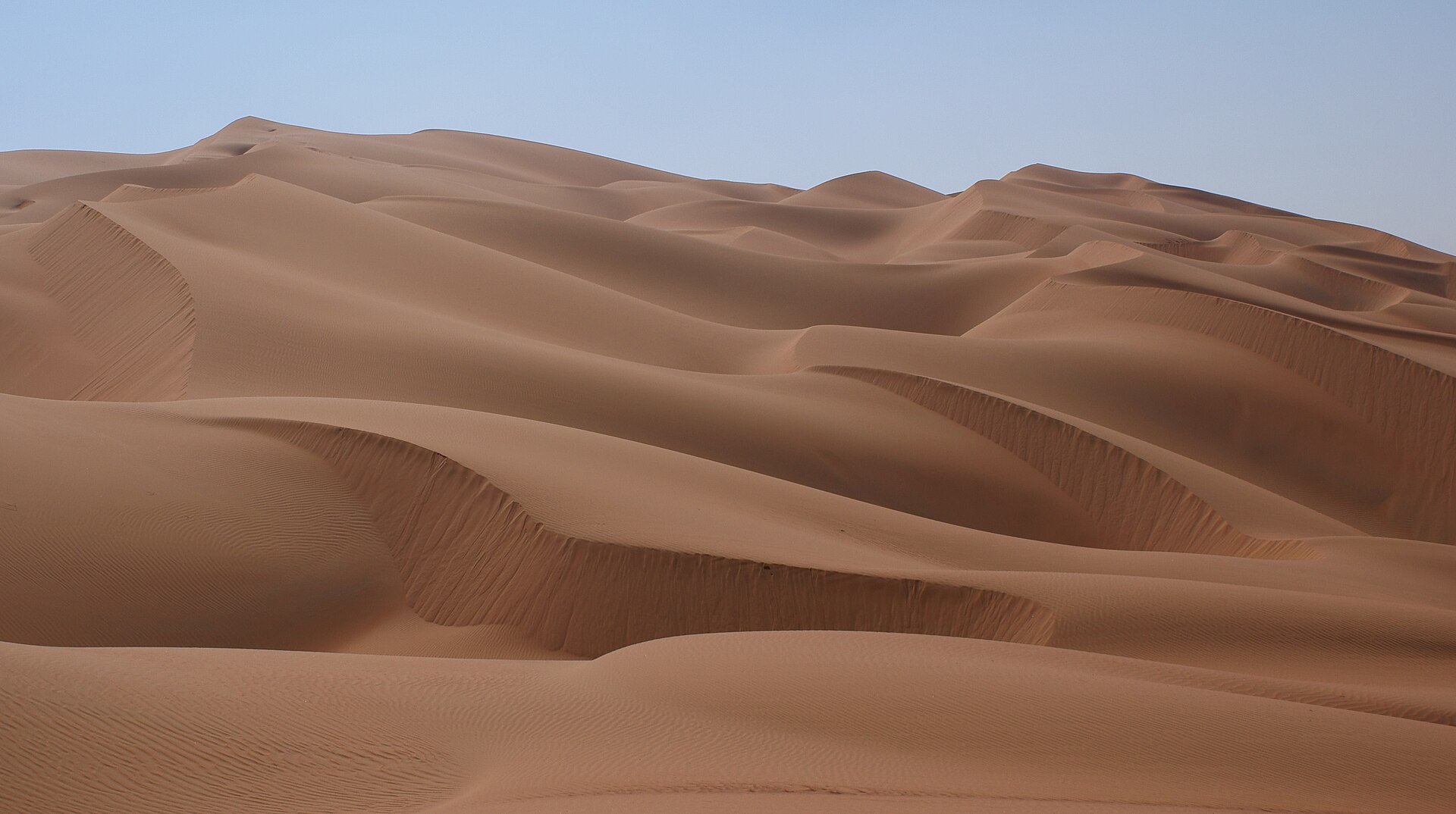
South of Abu Dhabi, the pavement runs straight into the largest sand desert on Earth. The Liwa loop takes drivers to the edge of the Rub al Khali — the Empty Quarter — where dunes rise three hundred metres and the horizon disappears into golden silence.
Approaching from Abu Dhabi and Dubai
The primary approach follows E11 (Sheikh Maktoum Bin Rashid Road) southwest from Abu Dhabi toward Tarif, then turns south on the Mezairaa–Liwa road. From Dubai, drivers take E611 to E11, or E311 to the Abu Dhabi connector — total distance from Dubai Marina is approximately 330 kilometres, requiring three to three-and-a-half hours with normal traffic.
The landscape shifts gradually. Urban sprawl thins, industrial zones give way to scrub desert, and finally the road straightens onto a causeway through sabkha flats where salt crusts whiten the earth. Palm plantations appear — the first sign of Liwa's underground aquifers feeding the oasis chain.
The Liwa oasis chain
Liwa is not a single town but a string of villages — Mezairaa, Hameem, Muzayri, and others — spread along a crescent of date palm plantations. Each settlement maintains the falaj irrigation tradition that made human life possible here for centuries. The drive between villages follows a paved road shaded intermittently by palm canopies.
Liwa Rest House and several date farms welcome visitors during harvest season (July through September). The Liwa Date Festival in July draws crowds; roads are busier during festival weekends. Off-season visits offer quieter roads and the same dune backdrop without event traffic.
Moreeb Dune — locally called Tal Mireb — is among the tallest dunes in the UAE, rising approximately 300 metres. A paved access road leads to a viewing area at the base. Climbing the dune on foot takes forty to ninety minutes depending on fitness. The annual Moreeb Hill Climb motorsport event transforms this quiet landmark into a competition venue each winter.
The desert loop route
A satisfying loop begins at Mezairaa, drives south through the oasis villages, continues to Moreeb Dune, then arcs west through desert roads toward Arada and back north to the E11 at Tarif or Hamim. The full loop covers roughly 250 kilometres of paved road with optional graded tracks for four-wheel-drive vehicles.
The western sections offer the most dramatic dune proximity — sand laps at the road shoulder, and dunes visible to the south appear close enough to touch. Wind reshapes these dunes seasonally; the landscape a driver sees in January may differ noticeably by March.
Desert driving conditions
Paved roads throughout the Liwa loop are well maintained and suitable for any vehicle. Graded tracks leading to remote dune faces require four-wheel drive and experience with soft sand. Recovery services exist in Mezairaa but response times increase with distance from the village centre.
Wind-blown sand reduces visibility during shamal events — seasonal northwesterly winds that can last two to four days. Check weather forecasts before departure. Summer temperatures exceed 48°C; travel between October and April is strongly advised. Carry at least two litres of water per person regardless of season.
Fuel, supplies, and connectivity
ADNOC stations operate in Mezairaa and at intervals along E11. Fill the tank before leaving the oasis chain for the western loop sections. Mobile coverage is reliable near villages but intermittent on remote desert tracks. Offline maps are essential for drivers venturing off the main paved routes.
When to drive
Winter weekends (November–February) are peak season — depart Abu Dhabi or Dubai before 7:00 AM to avoid Friday outbound congestion. Sunset from Moreeb Dune is spectacular; plan arrival two hours before dusk for the climb and photography window. Overnight camping is permitted in designated areas; winter nights drop to 10–15°C, requiring warm layers.